


Cabel or cable? It’s a small word that causes big doubt. You’re typing an email and you freeze. Which spelling is right? Your spell checker doesn’t always help. Many people get stuck here. You’re not alone. The short answer is simple. Cable is correct. Cabel is just a common mistake. It’s also a rare name.
So why does the cabel or cable mix-up keep happening? The word sounds like “kay-bul.” Your ear hears “bel,” so your fingers type it. A cable is a thick wire, a group of wires, or a strong rope. You see it on TV, internet, and phone chargers. The spelling is the same in the US and UK. You don’t need to pick a side. It only takes a few minutes. Let’s sort it out together. Read on, and the cabel or cable question will feel easy.
Cabel or Cable?
Yes, that heading looks odd, and it’s a fair reaction. Most people searching this are really asking about cabel vs cable, and only one of the two is a real English word. Let’s settle it fast.
Cable is the correct spelling. You’ll find it in every major dictionary, from Merriam-Webster to Oxford. The word cabel isn’t listed as a standard English word, so it counts as a misspelling.
Why does the mix-up happen? Say the word out loud and you hear “KAY-bul.” The second syllable sounds like “bel” in your head, so your fingers type it that way. English is full of endings like this, such as table, label, and able, so the cable spelling trips people up.
Where Did the Word “Cable” Come From?
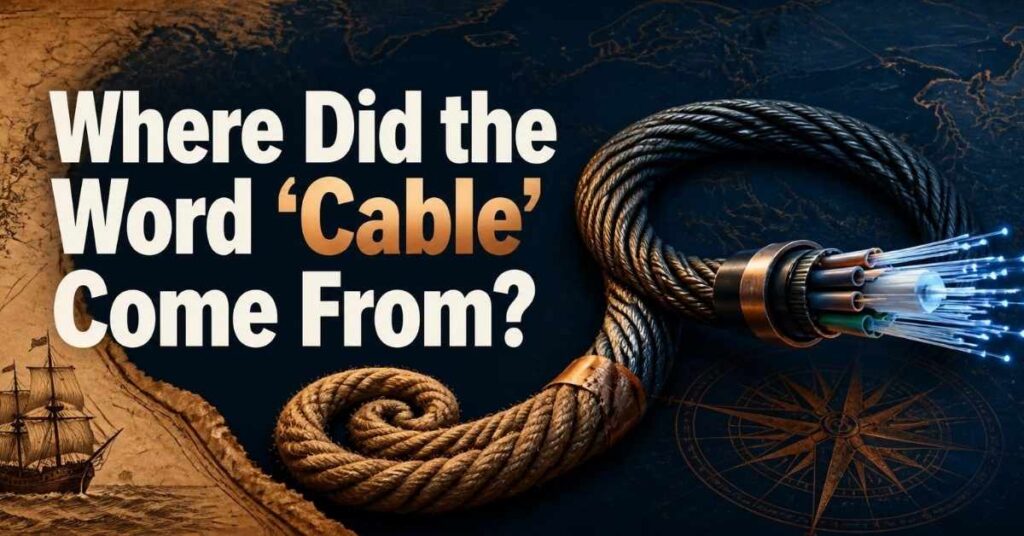
The cable meaning goes back centuries. According to the Online Etymology Dictionary, English borrowed it around the 1200s from Old French, which got it from Latin. The Latin root points to a rope or a lasso, something that holds or seizes.
That origin explains why a strong rope and a steel cable share one name. Sailors used thick anchor ropes and called them cables. Later, engineers used the same word for twisted metal strands, and then for bundles of insulated wires.
Here’s a fun detail. In nautical talk, a “cable” is also a unit of distance, roughly one tenth of a nautical mile. So the word has stretched from rope to wire to measurement, and the spelling never once included an “e” before the “l.”
British English vs American English Spelling
Good news: there’s no split here. British English spelling and American English spelling both use cable. You won’t find a UK or US version of cabel because it was never valid in either one.
Compare that with words like colour and color, or neighbour and neighbor. Those pairs do change across the Atlantic. Cable stays put, which makes it one of the safer words in British vs American English.
So if a spell checker underlines cabel in red, don’t blame regional settings. Switch it to cable and move on. It’s the standard spelling everywhere, from Manchester to Miami.
Read More: Synonyms for Contradiction: 50 Smart Swaps to Use in 2026
Which Spelling Should You Use? A Simple Guide

Since cable is the only correct form, the real question is how to use it for your audience. Different readers care about different things. Here’s a quick breakdown.
For American Readers
Write cable in every context. That covers TV cable, internet cable, USB cable, and HDMI cable. Pair it with US spellings elsewhere in your text, like “color” and “neighbor.”
If you run a US tech blog, keep product terms consistent. For example, say “USB cable” every time instead of switching between cable, cord, and lead.
For British and Commonwealth Readers
The spelling doesn’t change, but the surrounding words might. A Brit might say “lead” for a short power cord, or “flex” for flexible mains wiring. The word cable still applies to heavier electrical cable and underground cable.
Keep “neighbour” and “colour” in your British copy, and keep cable exactly as is.
For Global Readers
When your audience is mixed, use cable and define it once. Add a short phrase like “a cable (a group of wires wrapped in a protective sheath)” the first time it appears. Readers who learned English as a second language will thank you.
Avoid slang. A plain, standard English sentence travels further than a clever one.
For People Searching Prices
If you’re shopping, type cable and not cabel. Search engines forgive typos, but product filters and store catalogs usually don’t. A correct spelling gets you cleaner results.
Then narrow it down with specifics:
- Electrical cable price depends on the conductor material, thickness, and insulation.
- Cable price per meter changes with length, so compare the same gauge across sellers.
- Brand and certification marks matter for electrical safety, so don’t pick on price alone.
Always check the rating on the label before you buy. A cheap cable that overheats costs far more than a good one.
For Professional Writing
In professional writing and technical writing, precision wins. Use cable for a multi-conductor assembly, and don’t swap it with wire or cord just to avoid repeating yourself. Readers like electricians and a cable technician rely on those differences.
Run a final spell check, then search your document for “cabel” manually. Typos like this slip past tired eyes.
Common Mistakes and How to Fix Them
Most errors around this word fall into a few predictable buckets. Spotting them takes about ten seconds once you know the pattern. Here are the ones I see most often.
- Writing “cabel” for cable. Fix: end the word with “-ble,” just like table and noble.
- Using “cabal” by accident. A cabal is a small, secret group. Fix: if you’re talking about a wire or rope, it’s cable.
- Mixing cable and cord in the same sentence. Fix: pick one term per item and stick with it.
- Writing “cable” for a name. If someone’s name is Cabel, keep their spelling.
Here’s a tiny memory trick. Think “a cable is able.” Both end in “-ble,” and the “a” comes right before. That one phrase saves a lot of red underlines.
Read More: Synonyms for Living: 46+ Words Explained for 2026
Why Do People Misspell Cable as Cabel?
It comes down to sound and habit. English has many words ending in “-el” and “-le” that sound nearly identical. Think of “angel” versus “angle,” or “model” versus “noodle.” Your ear can’t tell the endings apart, so your hands guess.
Phones add fuel to the fire. Autocorrect may leave “cabel” alone if you’ve typed it before, especially if someone in your contacts carries that name. After that, the error keeps repeating itself.
Search habits matter too. People type fast, hit enter, and let Google fix it. That’s why you’ll often see search suggestions quietly correcting the typo.
Cable vs Cord vs Wire: What’s the Difference?
This is the second big confusion, and it matters more than spelling. A wire is a single metal thread, usually copper or aluminum, that carries current. A cable bundles two or more wires inside one outer jacket.
A cord is a flexible wire assembly built for portable use, like a lamp or kettle lead. Cords bend a lot and plug into outlets. So the cable and cord difference comes down to build and job: cables run inside walls or between devices, while cords power things you move around.
In short, wire is the strand, cable is the bundle, and cord is the bendy plug-in version. Real life blurs this a bit, since people call phone chargers either one. Still, the cable vs cord rule helps when you write or shop.
Cable in Everyday Life: Real Examples
Spelling rules only stick when you see them in action. Below are seven everyday spots where you’ll write or read this word. Copy any of these sentences if they help.
1. In a Work Email
Subject: “Replacement HDMI cable for Room 4.” Then the body: “Hi Sam, the projector cable is frayed. Could you order a new one by Friday?”
Short, specific, and spelled right. Your boss reads it once and acts.
2. In a News Headline
“Undersea cable repairs restore internet to coastal towns.” Headlines favor short, clear nouns, and cable fits well. A misspelling in a headline can hurt trust fast, so double check it.
3. On Social Media (Twitter/X)
“Third USB cable this month. Why do they all die?” Posts like this show how casual the word is. You’ll see the typo in replies more than in original posts, which is normal.
If you manage a brand account, fix typos quickly. Followers screenshot mistakes.
4. In a Formal Report
“The contractor installed 120 meters of armored underground cable along the east perimeter.” Formal reports need exact terms, so use cable for armored or multi-core runs. Add the material and length to show care.
5. In a Dictionary (Cord Dictionary)
Look up “cord” in a dictionary and you’ll see it defined as a string or rope, or a flexible insulated wire. That cord meaning overlaps with cable but isn’t identical. Check the wire meaning entry too, and you’ll see the three words cluster together.
Dictionaries also list a cable definition that covers rope, wire bundles, and telegrams. It’s worth a two minute read.
Read More: Synonyms for Simple: Which Word Works Best? (2026)
6. In Daily Conversation
“Can you grab that extension cable from the garage?” You say it without thinking, and nobody hears a spelling. That’s the root of the problem: the word lives in speech first, so the written form feels fuzzy.
Cable pronunciation is “KAY-bul.” Keep that in mind when you type.
7. Talking About a Neighbor
“My neighbor ran a cable across the fence for his Wi-Fi extender.” This sentence uses two spelling-sensitive words at once. In British English, you’d write “neighbour,” while cable stays the same.
It’s a handy example of how one sentence can hold a regional spelling and a universal one together.
Google Trends: What People Actually Search
I can’t quote live numbers here, so use Google Trends yourself and compare “cable” against “cabel.” You’ll see “cable” dominate by a huge margin, and “cabel” show up as a small, steady trickle. That gap tells you which spelling most readers expect.
The typo’s volume still matters for content. People who type cabel want a quick answer, so a clear page like this one can capture those searches. Topics like cable price, internet cable, and cable car also draw steady interest.
A good habit: check Trends by country. Searches for cable car spike in places like San Francisco, while TV cable queries shift with streaming habits.
Complete Comparison Table: All Word Variations
| Word | Correct? | Meaning | Example |
| Cable | Yes | Thick wire, wire bundle, strong rope | “Plug in the HDMI cable.” |
| Cabel | No (name or typo) | Misspelling of cable, or a rare name | “Cabel Smith joined the team.” |
| Cabal | Yes | A small secret group | “A cabal planned the move.” |
| Cord | Yes | Flexible insulated line, string | “Wrap the cord neatly.” |
| Wire | Yes | Single metal strand | “Strip the wire ends.” |
| Neighbour | Yes (UK) | Person living next door | “My neighbour waved.” |
| Neighbor | Yes (US) | Same, American spelling | “My neighbor waved.” |
Frequently Asked Questions
1. How do you spell cable in English?
C-A-B-L-E. It has five letters and ends in “-ble.” The same spelling works in the US, UK, Canada, and Australia.
2. What does the name Cabel mean?
Cabel is a rare spelling of the surname and first name Cabell. Sources tie it to a Norman French background, though the exact meaning is debated. As a name it’s fine, but it doesn’t mean wire or rope.
3. Does cord mean cable?
Not exactly. A cord is a flexible, usually portable line, while a cable is a bundle of wires in one jacket. People mix them up in speech, but in technical writing you should keep them apart.
4. Is it cabal or cable?
It depends on your meaning. Cabal is a small secret group, and cable is a wire or rope. If you’re writing about electricity, TV, or the internet, you want cable.
5. What is a cable car?
A cable car is a vehicle pulled along a track by a moving steel cable. The most famous example is the San Francisco cable car system, which began running in the 1870s. An aerial cable car, or gondola, hangs from overhead cables and carries riders up mountains.
6. What does the 📲 meaning plug emoji mean?
Quick correction: the plug emoji is 🔌. The 📲 emoji shows a mobile phone with an arrow, which people use for “call me” or “download this.” Use 🔌 when you talk about cable or power, and 📲 for phone related messages.
7. How do I find the best cable price?
Start with the exact type, like fiber optic cable or HDMI cable. Compare the cable price per meter across three or four cable suppliers, and check the gauge and rating. Read reviews for real world durability.
8. What is wire in meaning?
“Wire in” means to connect something to an electrical supply, as in “The electrician will wire in the new oven.” It’s common in British English. In everyday talk, it can also describe someone who’s plugged into a team or system.
9. In my capacity meaning – how do I use it?
“In my capacity as” means “in my role as.” For example, “In my capacity as team lead, I approved the budget.” It’s a formal phrase, so use it in business writing and skip it in casual chats.
10. What is meaning of neighbour?
A neighbour is a person who lives next to you or nearby. Neighbour is the British spelling, and neighbor is the American one. Both mean the same thing.
11. Can I use “cable” and “cord” interchangeably?
In casual talk, yes, and nobody will blink. In product listings, manuals, and technical writing, no. Pick the term that matches the build, and keep it consistent.
12. Why does Google show “cabel” sometimes?
Google often shows results for what you probably meant, so it may display “cabel” in suggestions or in autocorrect notes. It can also pick up the name Cabel. Neither means the spelling is correct.
Conclusion
Cabel or cable? Now you know the answer. Cable is the right spelling. Cabel is a typo or a rare name. The cabel or cable mix-up is common. It happens because the word sounds like “kay-bul.” Your ear hears “bel,” so your fingers type it. Even careful writers slip here. The spelling is the same in the US and UK. So there’s no regional trick to remember.
Next time you doubt the cabel or cable question, use this trick. A cable is able. Both end in “ble.” Keep cable apart from cord, wire, and cabal too. Each word has its own job. Then check your text once before you hit send. Did this cabel or cable guide help you? Tell us in the comments. Share it with a friend who keeps typing cabel. One small fix makes your cabel or cable choice look sharper.

Wang Fang is a language and grammar writer who enjoys making English easier to understand. She creates clear, practical content about grammar rules, vocabulary, word usage, sentence structure, and writing tips. Her goal is to help students, writers, and everyday learners improve their English with simple explanations and useful examples.